Name changed to protect patient confidentiality.
When Pauline first contacted me, she had reached a point that many older adults fear.
Following a period of illness and several months of gradually becoming less active, she was no longer managing independently at home. Everyday tasks such as getting out of bed, preparing meals and moving safely around the house had become increasingly difficult.
To help her remain at home safely, Pauline had carers visiting three times a day.
While this support was invaluable, Pauline found it frustrating.
She didn’t want people doing things for her.
She wanted to be able to do more for herself again.
Looking Beyond Care
During our first assessment, it became clear that Pauline’s biggest problem wasn’t simply her age.
She had become weaker which meant her balance had deteriorated and then her confidence had disappeared.
Like many people, she had slowly become less active over many months. That loss of activity had led to reduced strength, which made movement harder, leading to even less activity.
It was a cycle that needed breaking and a common theme through many of the cases I come across.
Rather than simply accepting increasing levels of care, Pauline wanted to see whether physiotherapy could help her regain some of the independence she had lost.
An Intensive Rehabilitation Programme
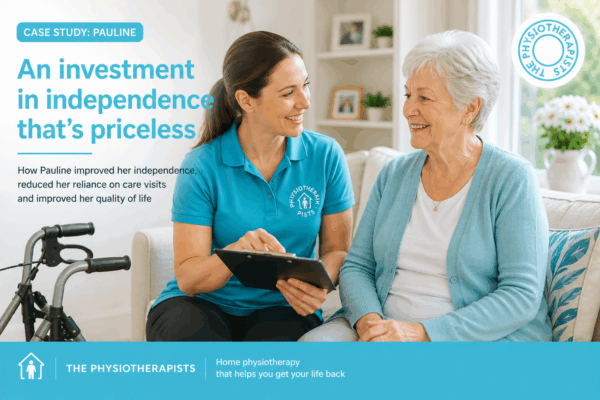
We agreed a six-week programme of home physiotherapy.
I visited Pauline twice each week, giving us regular opportunities to progress her rehabilitation while ensuring she felt supported throughout. This also kept her accountable as she knew I’d be back in a few days.
Between visits, Pauline completed a personalised exercise programme and practised the functional tasks that mattered most to her.
Our focus wasn’t on complicated exercises.
It was on improving the things that make everyday life easier:
- Standing up from a chair independently
- Walking confidently around the house
- Improving balance
- Building lower limb strength
- Practising everyday tasks safely
- Increasing confidence
Each week, Pauline became a little stronger.
Each week, she became a little more confident.
Those small improvements quickly began to add up.
Independence Has Value
By the end of the rehabilitation programme, Pauline was completing many everyday tasks that she had previously relied on carers to help with.
As her independence increased, the level of support she required reduced.
Every person’s situation is different, but for some people, improved mobility can mean fewer care visits or shorter visits, helping to reduce ongoing care costs as well as increasing independence.
Looking at the Bigger Picture
People sometimes hesitate when they see the cost of private physiotherapy.
It’s understandable.
A six-week programme costing around £600 can initially feel like a significant investment.
However, it’s worth considering the wider picture.
Private home care in Brighton typically costs around £25–£35 per hour.
Someone receiving three 30-minute care visits each day may therefore be spending around:
- Approximately £45 per day
- Around £315 each week
- More than £16,000 per year
If, following rehabilitation, someone is safely able to reduce just one 30-minute care visit each day, that could equate to a saving of around £5,000 per year.
Reducing two visits per day could potentially save considerably more.
Every situation is different, and care should only ever be reduced following appropriate assessment and agreement with the individual, their family and care providers.
Rehabilitation Doesn’t Stop After Six Weeks
One thing I often explain to people is that rehabilitation doesn’t have to end once an intensive programme finishes.
Many clients choose to continue with physiotherapy once a week or every fortnight.
This helps maintain strength, monitor progress and continue working towards new goals.
Even ongoing physiotherapy can compare favourably with the long-term cost of regular care visits, particularly if it helps someone remain more independent for longer.
The Greatest Return Isn’t Financial
Although reducing care costs can be an important benefit, it was never Pauline’s main motivation.
What mattered most to her was:
- Making her own cup of tea.
- Getting dressed with less assistance.
- Walking confidently around her home.
- Feeling in control of her own life again.
Those are things that can’t easily be measured in pounds and pence.
Physiotherapy isn’t simply about helping people move better.
It’s about helping people regain confidence, maintain dignity and continue living life as independently as possible.
For Pauline, that was the greatest return on her investment.
Could Physiotherapy Help You Stay Independent?
If you or someone you care about is becoming increasingly reliant on support at home, physiotherapy may help improve strength, confidence and mobility.
While every person’s circumstances are different and outcomes can never be guaranteed, many people are surprised by how much they can achieve with a structured rehabilitation programme delivered in their own home.