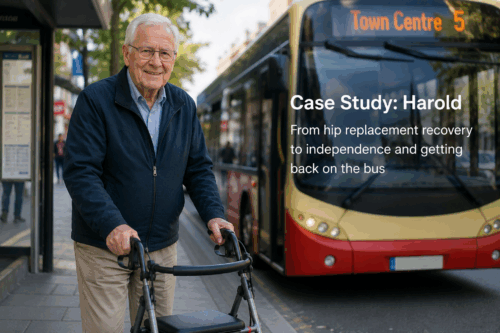
Name changed to protect patient confidentiality.
When Harold contacted me, he had already made up his mind that he wanted to do more.
He had recently undergone an elective hip replacement surgery and, although the operation had been successful, recovery was proving slower than he had hoped.
Like many people following a hospital admission, Harold had been discharged home with support from carers and ongoing NHS physiotherapy. He was receiving visits from carers three times a day and had a physiotherapy programme in place.
The problem wasn’t that he wasn’t receiving support.
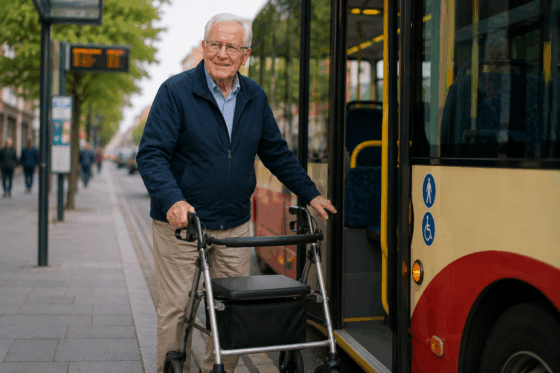
The problem was that Harold wanted to progress faster. The weekly visit from the physio and adherence to a sheet of exercises, wasn’t cutting the mustard and he wanted to do more but was unsure of exactly what to do and was concerned there may be risks. He was also aware that the care would soon start costing him money and the high cost was also concerning him, especially as he had been independent before.
Harold had seen one of my flyers and got in touch directly to discuss whether additional physiotherapy could help him regain his independence more quickly.
Setting a Goal
During our first assessment, it became clear that Harold was highly motivated.
He wasn’t interested in simply maintaining his current level of function, he wanted to get back to living his life.
Although he was managing short distances around his home with a four-wheeled walker, he lacked confidence outdoors and was still heavily reliant on support from others.
Most importantly, he had stopped doing many of the things he enjoyed.
Rather than focusing solely on exercises, we agreed on a series of practical goals that would have a meaningful impact on his daily life.
A More Intensive Approach
Alongside his existing rehabilitation programme, we worked together three times a week.
Early sessions focused on:
- Improving walking quality and endurance
- Building lower limb strength
- Improving balance and confidence
- Practising transfers and functional activities
- Managing fatigue and pacing activity
As Harold’s confidence improved, we gradually increased the challenge.
We began working on steps and uneven surfaces.
We practised negotiating kerbs safely.
We worked on road crossing skills and outdoor mobility.
Every session was focused on helping Harold become more independent in real-world situations rather than simply performing exercises indoors.
Taking Rehabilitation Into the Community
One of the advantages of home physiotherapy is that rehabilitation can take place where it matters most.
Once Harold was managing well around his home and immediate surroundings, we started venturing further afield.
Together we practised walking in the local community using his four-wheeled walker.
We worked on navigating busy pavements, crossing roads safely and managing the unexpected challenges that often arise outside the controlled environment of a clinic.
These are often the situations that people worry about most following surgery.
The physical ability may be there, but confidence takes longer to return.
The Big Milestone
Throughout rehabilitation, Harold kept mentioning one thing.
He wanted to get back into town independently.
For many people, this might sound like a simple goal.
For Harold, it represented freedom.
It meant being able to get out of the house, meet people, browse the shops and get back to some of the routines he had enjoyed before surgery.
After weeks of gradual progression, we reached an important milestone.
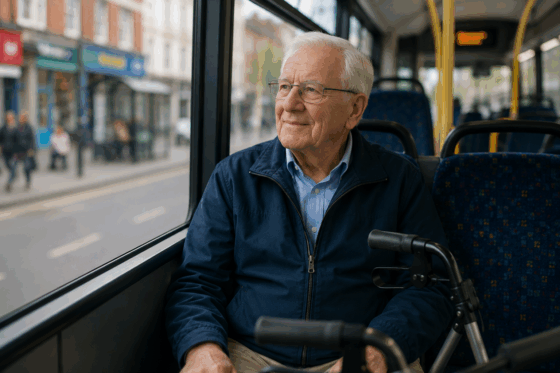
Together, we caught the bus into town.
What might seem like an ordinary journey for most people represented months of hard work, determination and perseverance.
More importantly, it demonstrated that Harold was once again capable of participating in the community with confidence.
The Outcome
By the end of our work together, Harold had:
- Improved his walking endurance and confidence
- Become more independent with everyday activities
- Successfully negotiated steps and kerbs
- Improved his outdoor mobility
- Regained confidence crossing roads safely
- Returned to travelling into town by bus
- Reduced his reliance on support from others with a significant financial saving.
Most importantly, he had regained the confidence to get back out into the world.
Taking Control of Recovery
One thing Harold’s story highlights is that recovery doesn’t have to be passive.
Many people are motivated to push beyond the minimum required to get by.
They want to walk further, do more and return to the activities that give their lives meaning.
Physiotherapy is not just about recovering from surgery.
It’s about helping people achieve the level of independence and confidence that matters to them.
For Harold, that wasn’t simply walking around his house.
It was getting back on the bus and reclaiming a part of his everyday life.
To book an 15 minute free consultation to see if home physio could work for you
