
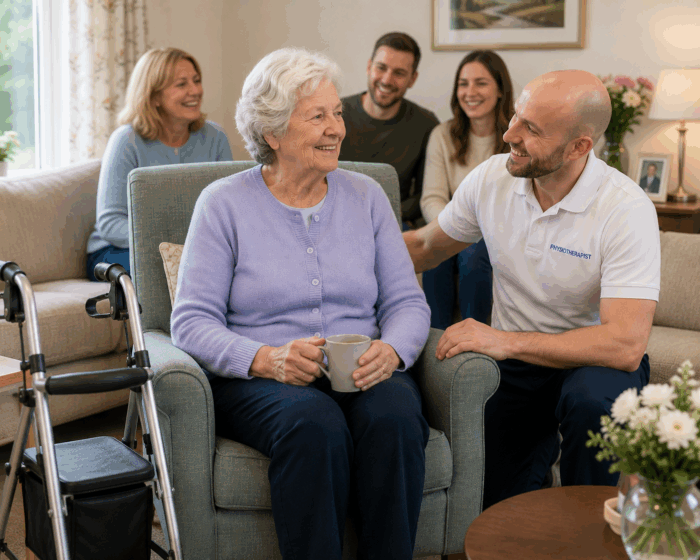
Name changed to protect patient confidentiality.
When Judith’s family contacted me, they were understandably perplexed.
A few weeks earlier, Judith had been living independently at home and managing her daily activities without significant support. Then she suffered a fall and attended Accident & Emergency.
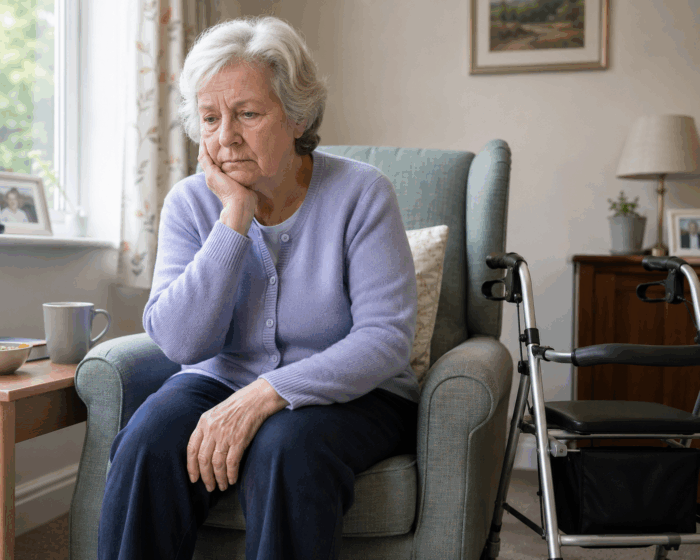
Fortunately, she had not sustained any major injuries, and after assessment by the hospital team, she was discharged home. However, something had changed.
Almost overnight, Judith appeared to have gone from walking independently to spending most of her day either in bed or sitting in a chair. Her family couldn’t understand how such a dramatic decline had happened so quickly.
Was It Really the Fall?
One of the most common things I hear from families is:
“She was fine before the fall.”
In reality, falls are often the final stage of a much longer process.
When I assessed Judith, it became clear that the fall itself was only part of the story.
Over many months, Judith had gradually become less active. She was walking shorter distances, spending more time sitting down and avoiding activities that had become more challenging. Like many older adults, these changes happened so gradually that neither Judith nor her family fully appreciated how much her strength and balance had declined.
The fall was not the cause of all her problems. It was a symptom of a gradual loss of strength, balance and in turn, confidence that had been developing for some time.
Following the fall, fear became the biggest barrier.
She had lost confidence in her ability to move safely and became worried about falling again. As a result, she moved less, which led to further weakness and reduced confidence.
A vicious cycle had begun.
Developing a Plan
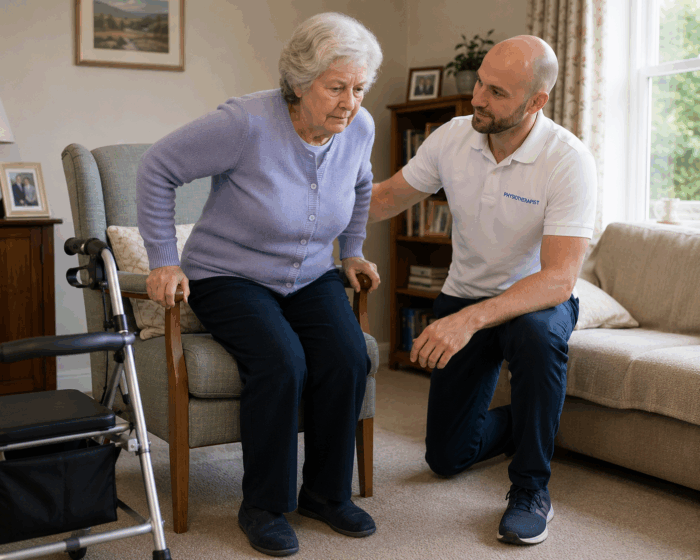
We agreed a six-week programme of home physiotherapy with visits twice each week.
Our initial focus was not on walking long distances.
Instead, we concentrated on rebuilding the foundations of mobility:
- Improving lower limb strength
- Practising safe transfers
- Improving standing tolerance
- Rebuilding confidence
- Improving balance
- Increasing daily activity levels
We also involved Judith’s family wherever possible so they felt confident supporting her between visits.
This allowed regular practice throughout the week rather than relying solely on physiotherapy sessions.
Small Wins Become Big Improvements
Initially, simply standing up from a chair was a challenge.
Like many people following a fall, Judith had begun to avoid movement because she was frightened of what might happen.
Rather than pushing too hard too quickly, we focused on small, achievable goals.
Every success built confidence.
Every improvement encouraged more movement and we were able to focus on the small victories and celebrate these. Keeping her motivated and helping her confidence to grow again.
Every extra step helped break the cycle of inactivity and deconditioning.
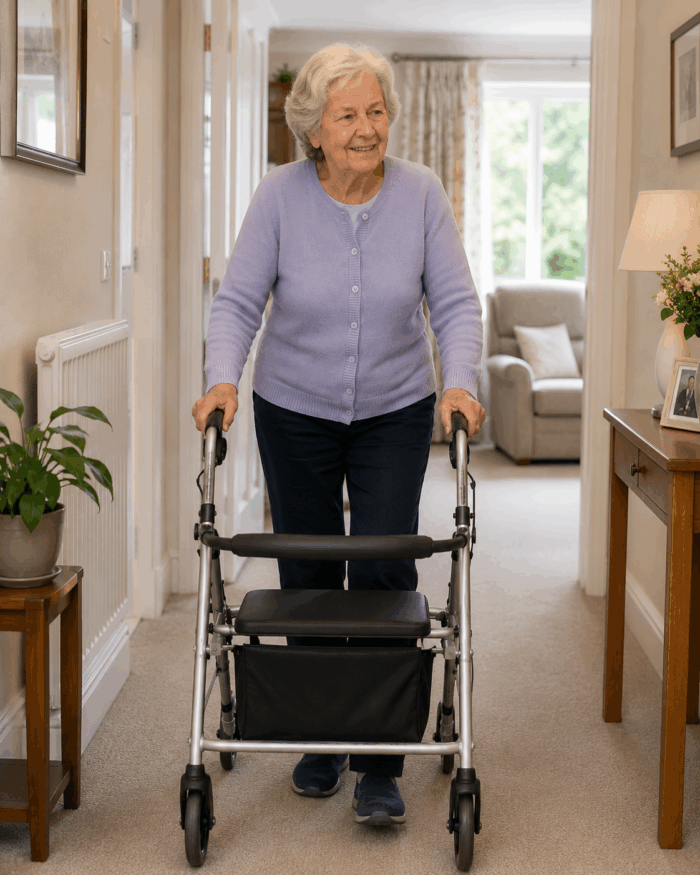
Over the following weeks, Judith gradually progressed from short periods of standing to walking around her home more confidently and independently.
As her physical abilities improved, so did her confidence.
The Turning Point
The biggest change wasn’t actually physical.
It was psychological.
Judith stopped seeing herself as someone who had fallen and started seeing herself as someone who was recovering.
That shift in mindset allowed her to become more active, more independent and more willing to challenge herself safely.
Her family also became more relaxed, knowing how best to support her without taking over tasks she was capable of doing herself and feeling again that they could leave her on her own safely.
The Outcome
After six weeks of rehabilitation, Judith had made significant improvements.
She was:
- Walking independently around her home
- Completing transfers with much greater ease
- More active throughout the day
- More confident in her mobility
- Less fearful of falling
- Requiring significantly less assistance from family members
Most importantly, she had regained a level of independence that both she and her family feared had been lost forever.
What Families Can Learn From Judith’s Story
Falls rarely happen completely out of the blue.
They are often the result of a gradual decline in strength, balance, confidence or activity levels that may go unnoticed until something significant happens.
The good news is that many of these factors can be improved.
With the right assessment, a tailored rehabilitation programme and support from family members, it is often possible to rebuild strength, confidence and independence.
If you are worried about a parent or relative who has become less mobile following a fall, physiotherapy may be able to help.
Sometimes the fall isn’t the end of independence.
It is simply the point at which the family recognises that support is needed.
